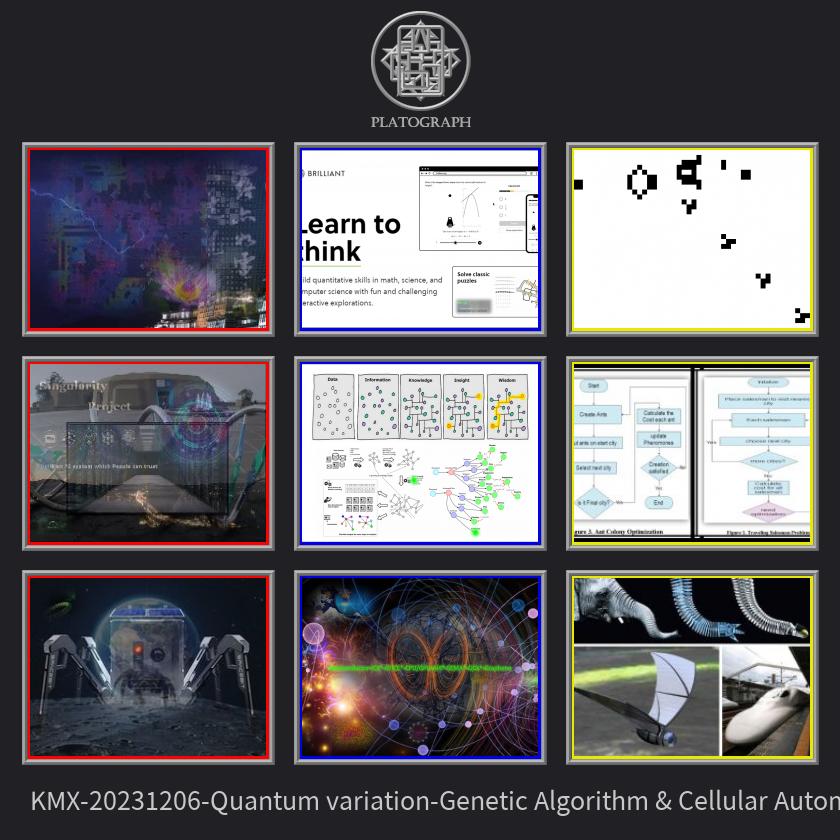
The general discussion from the above documents revolves around several topics related to machine learning, robotics, biomimicry, DNA computing, cellular automata, and technological evolution.
D1 focuses on how machine learning techniques can accelerate the robotic industrial revolution by incorporating ideas from cybernetics and creatures' evolutionary gifts. The concept of automation, cyborgs, and biomimicry are explored in this document.
D2 delves into DNA computing and its application to complex data analysis. It discusses the use of evolutionary or genetic algorithms in DNA sequence analysis, data storage and encryption, digital complexity, and efficient encoding. The document also touches upon the relationship between entropy, bioinformatics, and cellular automata.
D3 explores the concept of cellular automata in adaptation, emphasizing the keys of natural evolution such as mutation, adaptation, and reproduction. It questions whether inorganic machines can evolve to possess consciousness, highlighting the differences between inorganic and organic systems.
K1 discusses the importance of learning to think in challenging interactive explorations, suggesting that it is crucial for progress and development in various domains.
K2 focuses on bringing order to chaos through graph-based approaches, particularly in transforming textual data into wisdom. It mentions the relevance of GraphAware in this context.
K3 addresses the grand design of technological evolution towards AI-oriented quantum computing revolution, highlighting the significance and potential of this field.
H1 presents a compilation of animal-inspired inventions and how they offer brilliant bio-design solutions.
H2 discusses optimization techniques, specifically genetic algorithms and ant colony optimization, in solving the Traveling Salesman Problem. Swarm robotics, a domain of artificial intelligence, is also mentioned.
H3 provides an overview of cellular automata, a discrete model of computation studied in automata theory. It touches upon its applications in physics, theoretical biology, and microstructure modeling. References to notable figures in the field, such as Stanislaw Ulam, John von Neumann, Stephen Wolfram, and Conway's Game of Life, are mentioned.
Overall, the documents cover various aspects of machine learning, robotics, DNA computing, cellular automata, and their potential applications or impacts in different fields.
機器學習技術如何加速自動化/人機協作/仿生學的機器人工業革命,這是基於生命科學中的控制論思想的概括。機械生物學提供了從進化角度觀察並學習的機會,透過這些概念,利用機器學習的方法充分發揮生物演化的概念,以加速機器人的自主能力和適應能力。
其中的DNA計算是一項有趣和潛力巨大的領域,它利用進化和遺傳算法的思想來解決複雜數據問題。通過將DNA序列與旅行商問題的算法結合運用,可以有效地儲存和加密數據,實現數據的高效編碼和解讀,同時也適用於生物信息學和細胞自動機中的熵和複雜性分析。
細胞自動機是一種研究自動機理論的離散計算模型,它有廣泛的應用,包括物理學、理論生物學和微結構建模等領域。這種思想最初由Stanislaw Ulam和John von Neumann提出,而Stephen Wolfram則在Conway's Game of Life中做出了重要貢獻。細胞自動機的研究揭示了自然界中的生物演化和進化的關鍵機制,同樣也提示著無機機器無法具備意識和自主進化的能力。
在這些研究的基礎上,我們需要在交互式探索中學會思考和解決難題,同時也需要利用圖譜生成的方式來將文本數據轉化為知識。技術演化的最終目標是實現人工智能導向的量子計算革命,這需要我們不斷創新,並掌握技術的全局設計。
與自然界相比,動物在生物設計中有著卓越的創新。這些創新可以激發我們設計出更好的仿生產品和技術,從而改善生活品質。同時,運用遺傳算法和螞蟻群算法等優化技術,我們可以更有效地解決旅行商問題,同時也發展出了融合人工智能和群體協作的新領域,即群體機器人。
總結而言,這些研究提供了一個將控制論和生物概念應用於機器學習和機器人技術的框架,從而開展自動化、協作和仿生學等領域的革命。透過這些方法,我們能夠探索和學習生物演化的本質,並將其應用於機器人的自主能力和適應性上,從而推動機器人工業的發展和進步。